Box
Claiming the quadrant the enterprise software industry didn’t believe existed.
Hired in August 2016 to reposition Box before the platform players could make it irrelevant. Eighteen months later, the stock had gone from $11 to $26.
In 2016, Box had a problem that every quarter’s earnings call surfaced in the same question: how are you going to survive if you’re just a feature in someone else’s product? The company had never established a distinct market position beyond “secure file sharing,” and enterprise buyers couldn’t see why the offering mattered. The investor framing — feature versus platform — was becoming a death sentence. Without a defensible position above the commodity layer, Box would be absorbed by the larger players who could afford to give file sync away as a free feature inside a broader suite.
The work was to reposition Box as the infrastructure needed to run the modern enterprise before the deluge of competitive features made it irrelevant.
I was hired on August 8, 2016. BoxWorks — the company’s major customer event and its single largest moment of the year — was September 6–9. Four weeks out. The CEO wanted the brand work landed in time for the keynote. Telling him it couldn’t be done in four weeks was the right answer and also the wrong answer; the brand work as a complete strategic platform wasn’t possible in that window, but the keynote was happening regardless and could either reinforce the existing positioning or seed a new one. Two weeks in, I redirected the keynote around a single argument: the modern enterprise was unsurvivable chaos — a cacophony of repositories and systems that was collapsing by its own gravity — and that only Box was positioned to bring all of that back into the order needed to thrive. The essential step was bringing it all together so that information and people could work as one, rather than as a collection of departments.
The keynote landed. Work as One existed as a creative argument before it existed as a brand strategy. The framework that would later justify it was built over the following nine months.
The strategic reframe was a 2x2 that surfaced a quadrant the enterprise software industry hadn’t believed could be credibly occupied. Two axes — Level of Integration (Tool to Solution) and Level of Advocacy (Difficult to Simple) — plotted the competitive landscape into three clusters. The consumer-grade simple tools — Slack, Quip, Google Suite, Dropbox — clustered in the upper-left. The difficult enterprise solutions — SharePoint, OpenText, IBM — clustered in the lower-right. The niche enterprise tools clustered in the lower-left. The upper-right — simple and a full solution, accessible to all and capable of organizing an entire operation — was empty. The industry had organized itself around the assumption that you had to choose. Box was arguing for a category that didn’t yet have a credible occupant.
The reframe helped the executive team see Box not as just another player in a crowded space, but as a differentiated platform that was deeply integrated into our clients’ organizations and able to be used by any part of the organization together. Once we aligned internally, we took this argument to the analyst community, helping both Gartner and Forrester understand that their own analysis of the industry — which separated Enterprise File Sync and Share from Enterprise Content Management — was the wrong lens. Box wasn’t competing with Dropbox, OneDrive, SharePoint, or OpenText. Box was claiming a new quadrant.
A Three Horizons argument gave the work its operating cadence. Horizon 1 was consolidating the framing and positioning. Horizon 2 was expanding into adjacent categories — featurization of new capabilities, decommoditization of the core offering. Horizon 3 was repositioning Box as the central hub or workspace of modern work, not as an adjacent SaaS product. The brand work being commissioned couldn’t be calibrated to H1 alone, because optimizing the current category position would harden Box’s framing as a file-sharing tool and make the H3 future unreachable. The work had to ship today and architect tomorrow.
The operational rollout over the next eighteen months was where the strategy met execution. By mid-September I had audited the entire global marcom and sales enablement tooling. By October I had restructured the marketing activation budget across top-of-funnel, middle-of-funnel, and bottom-of-funnel communications. In November I hired a Senior Director of Content Strategy out of Google to build the campaign architecture across the three primary audiences — IT Managers, Enterprise Content Managers, and Developers. A fourth audience emerged before launch: Chief Security Officers, whose board-level concerns in 2017 made enterprise security a buying-committee priority that hadn’t existed in the original audience model.
January 2017 was the first external test of the work, going into the Gartner and Forrester reviews and rolling the strategy out to other divisions as published truth. The brand strategy deck that documented the 2x2, the Three Horizons framework, and the positioning argument became the internal operating document for the company. March was the relaunch of box.com with new content programming across US, EU, and Japan. April was the launch of Work as One across global publications — Box’s first major brand campaign. June was the launch of The Blueprint for the Future of Work, an ongoing thought leadership platform built to make the strategic argument visible through customer transformations rather than through claims about Box itself.
September 2017’s BoxWorks was the full activation. The entire event was The Blueprint for the Future of Work. One year after the chaos-to-order keynote that had seeded the strategy, the company’s flagship customer moment was the strategy fully realized.
The positioning that anchored all of it was a single sentence: Box ignites untapped potential by bringing people and information together. Eight words doing the same work the Condé authority statements and the Stitch Fix purpose-promise-positioning did at scale — a sentence load-bearing enough to organize an eighteen-month operational program, simple enough that every team across the company could ship against it.
The business outcome moved with the work. Brand recall increased 40% during the campaign run. Brand desirability rose 30%. Analyst and investor understanding of the business shifted from “file sharing competing with Dropbox” to “the platform layer for the future of work.” The share price moved from $11 in August 2016 to $26 by April 2018 — and continued to climb after. Whether the brand work caused the multiple expansion or correlated with it is a question the case study can’t definitively answer; what’s defensible is that during the period the work was running, the company’s framing in the market changed and the share price followed.
What this work proved, more than anything specific to Box, is that enterprise software can be culturally legible at consumer-brand altitude. The default assumption in enterprise SaaS is that B2B brands operate in a separate universe from B2C brands — sold to different buyers, evaluated on different criteria, expressed in a different register. That assumption produces the lower-right quadrant: companies that are powerful at scale and culturally invisible. Box’s argument was that the quadrant didn’t have to be a constraint. Enterprise software could be sold to enterprise buyers and still operate at the altitude of cultural legibility that consumer brands had monopolized. That argument has only gotten more relevant as the next generation of enterprise AI companies has emerged, each facing the same structural question about whether B2B and consumer-brand altitude have to remain separate categories.
The 2x2 was the diagnostic. Work as One was the campaign. The Blueprint was the platform. The argument was that the category Box was claiming didn’t yet exist — and that claiming it was the only way to keep from being absorbed by the players who already occupied the quadrants Box couldn’t credibly fight in.
The quadrant turned out to be real.
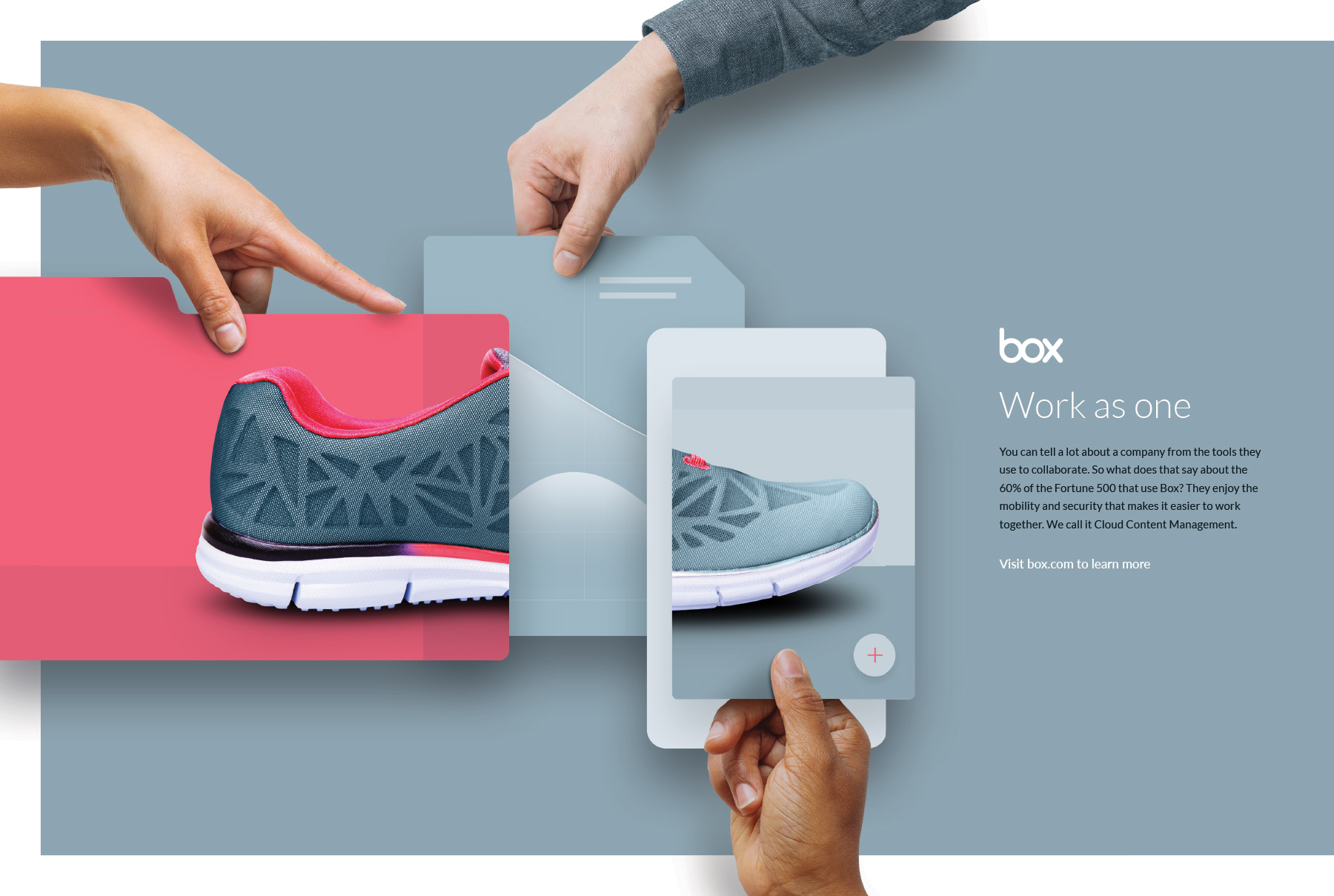
We bought a consistent back cover of MIT Technology Review, but launched with a series of spreads to kickstart the Work as One campaign.
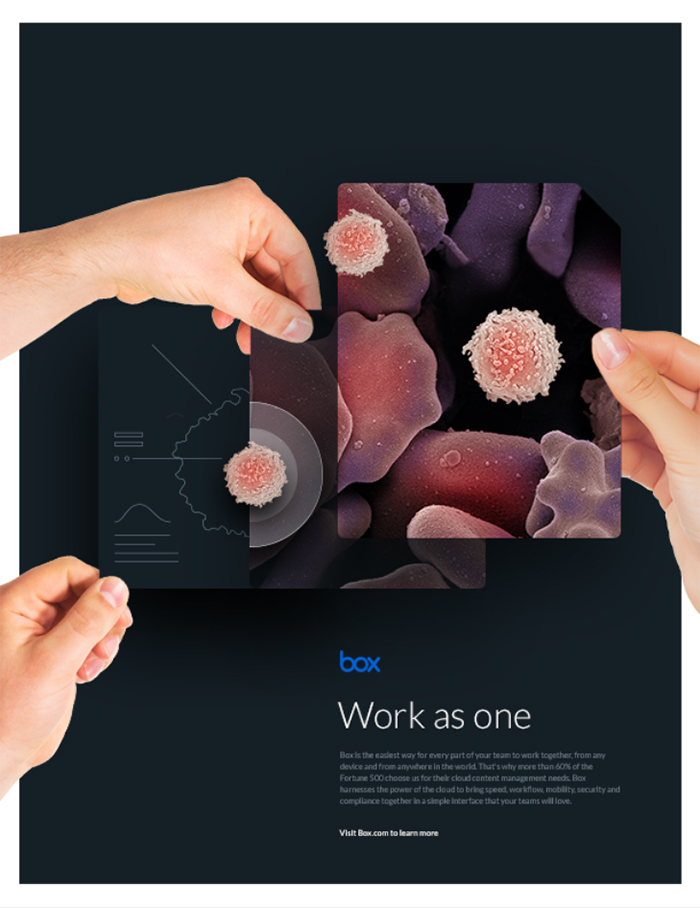
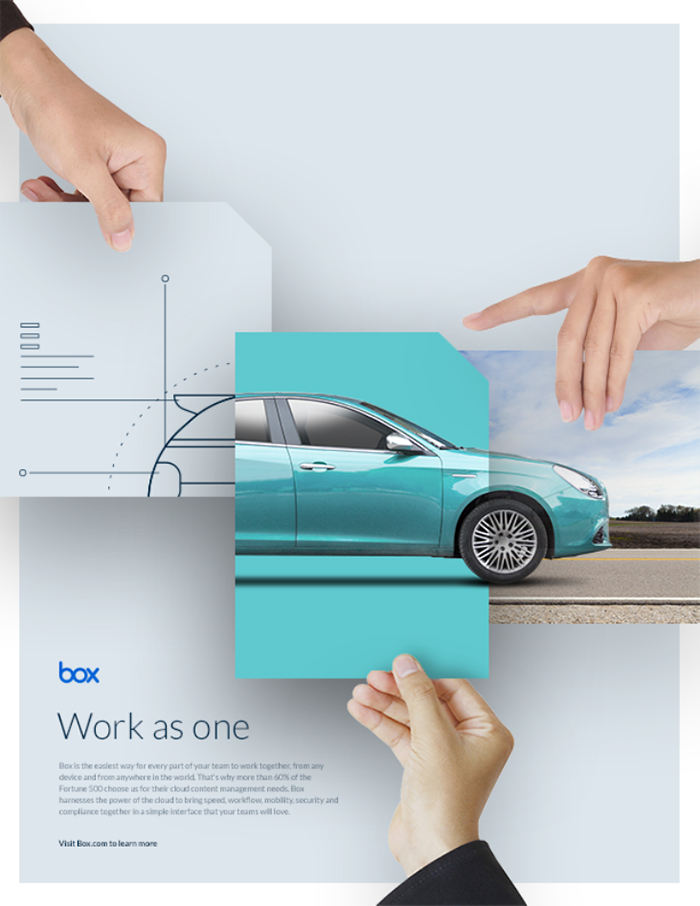
Some of the additional print ads for the Work as One campaign.
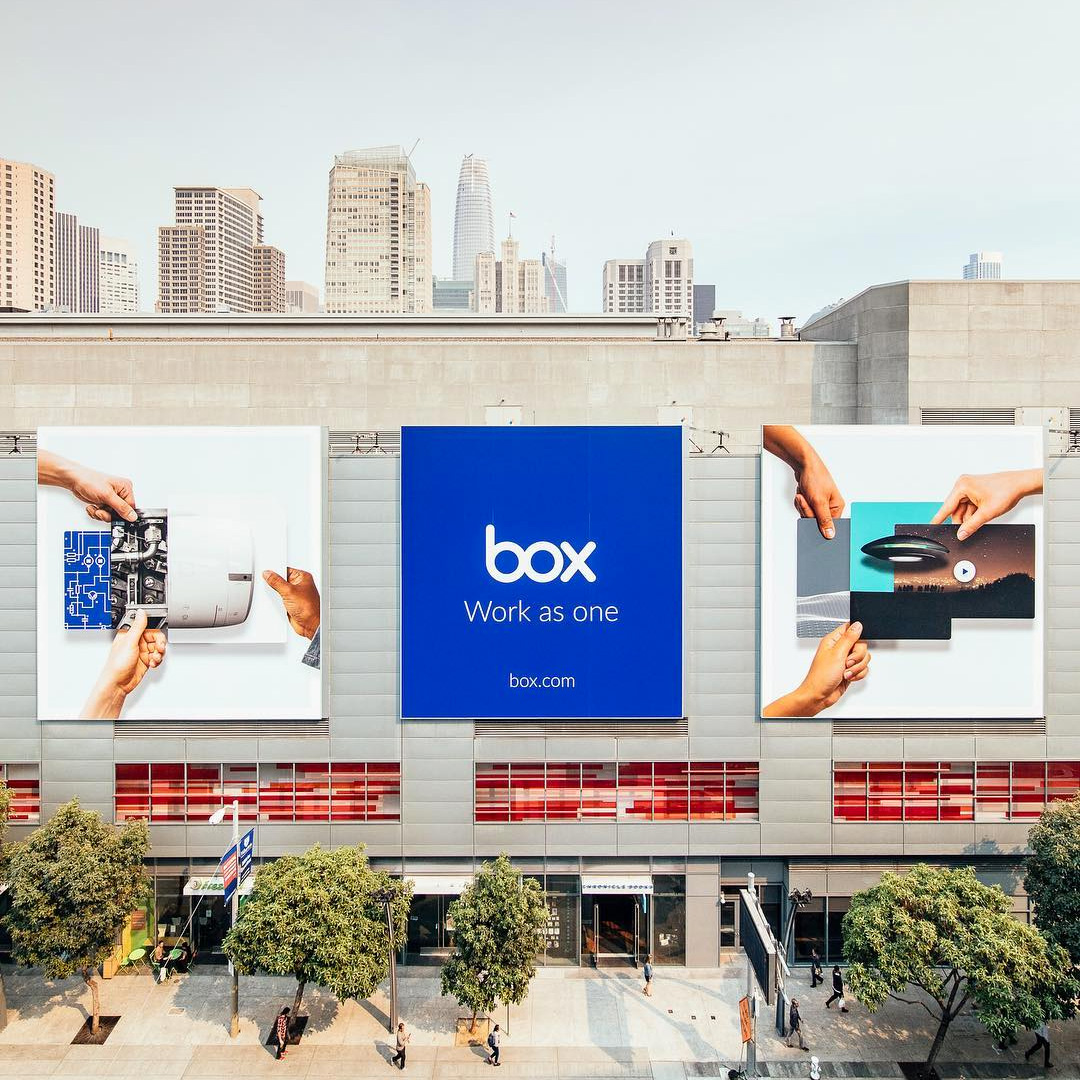
Our environmental takeovers for Moscone West during BoxWorks17. We pulled the campaign creative throughout the entire environment, reinforcing the concept at the same time we laid the foundation for the Blueprint for the Future of Work.
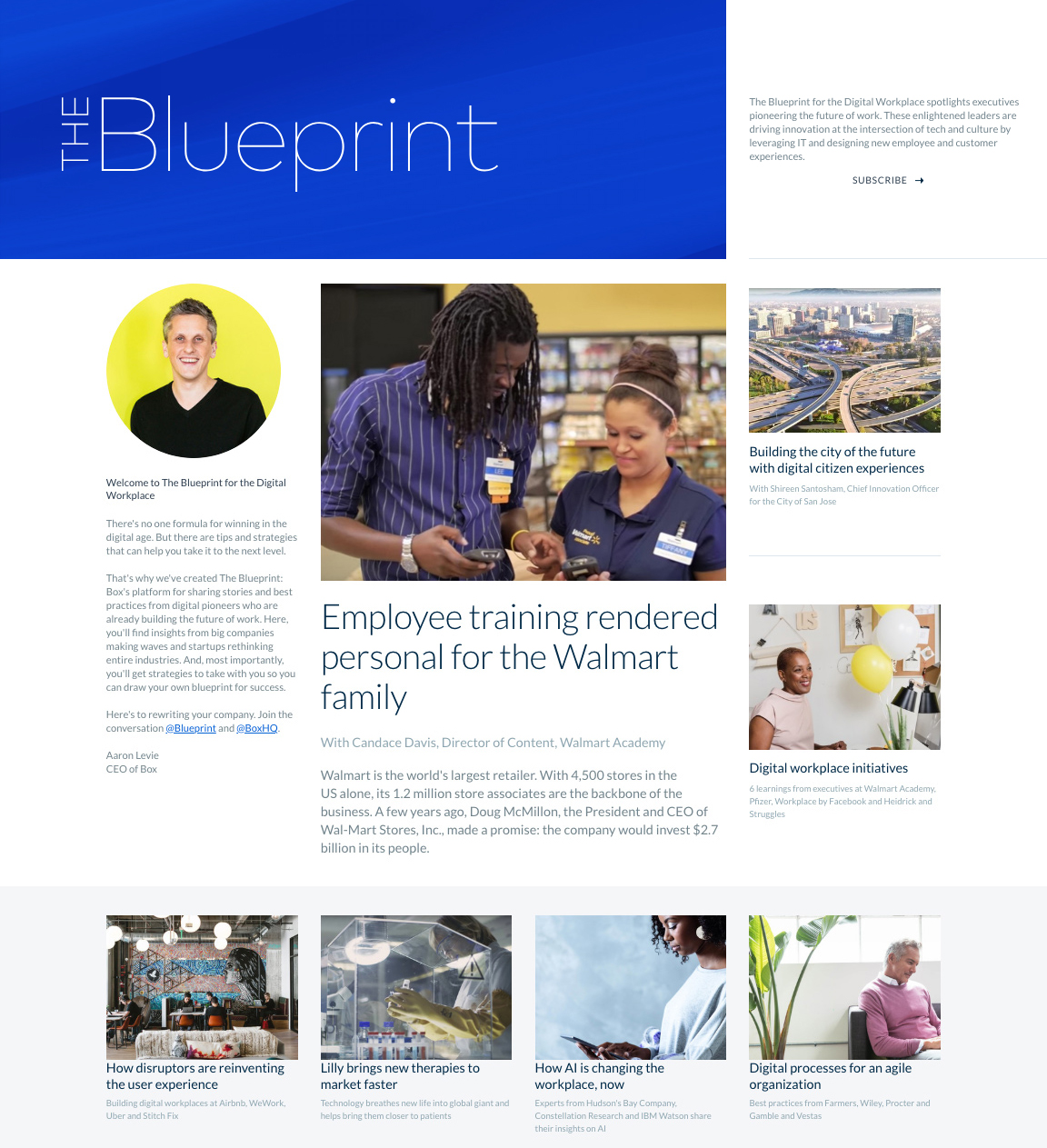
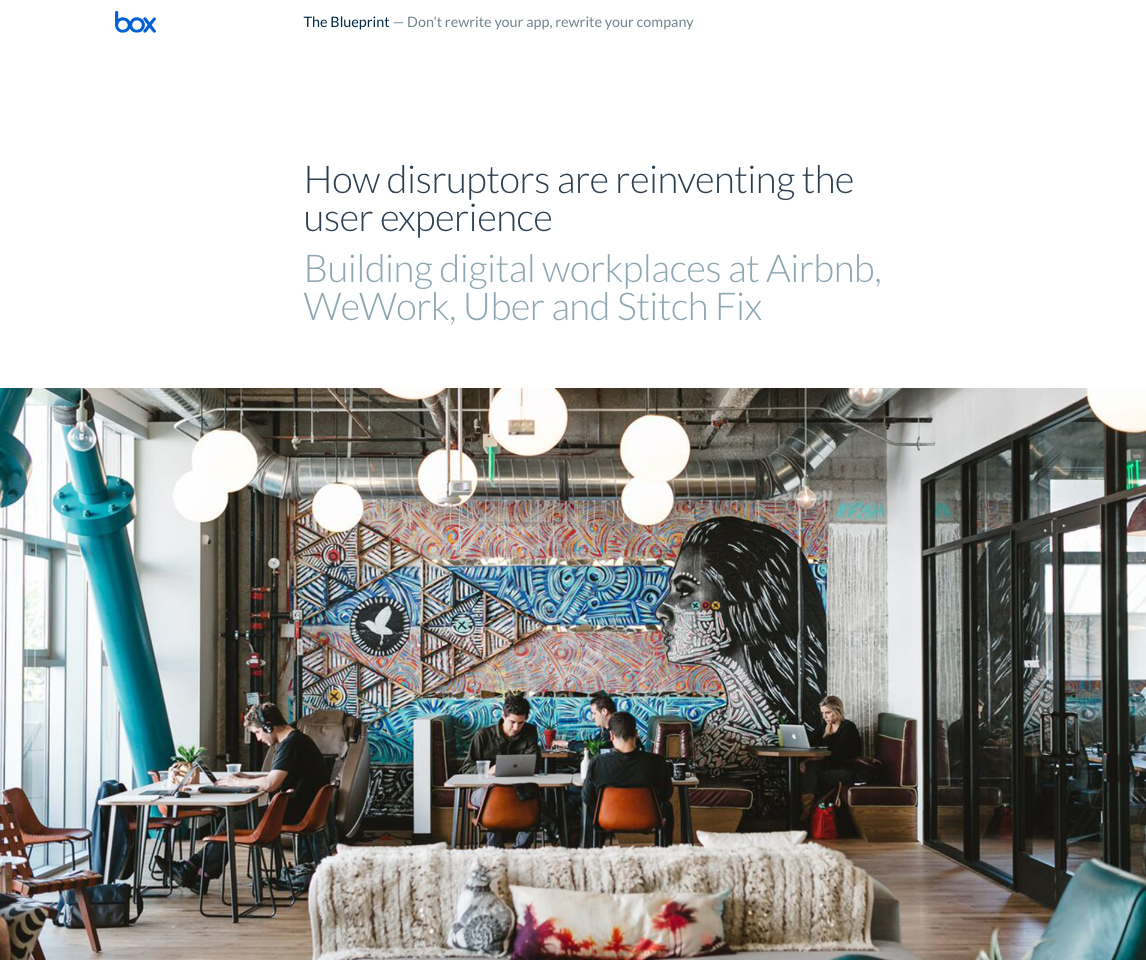
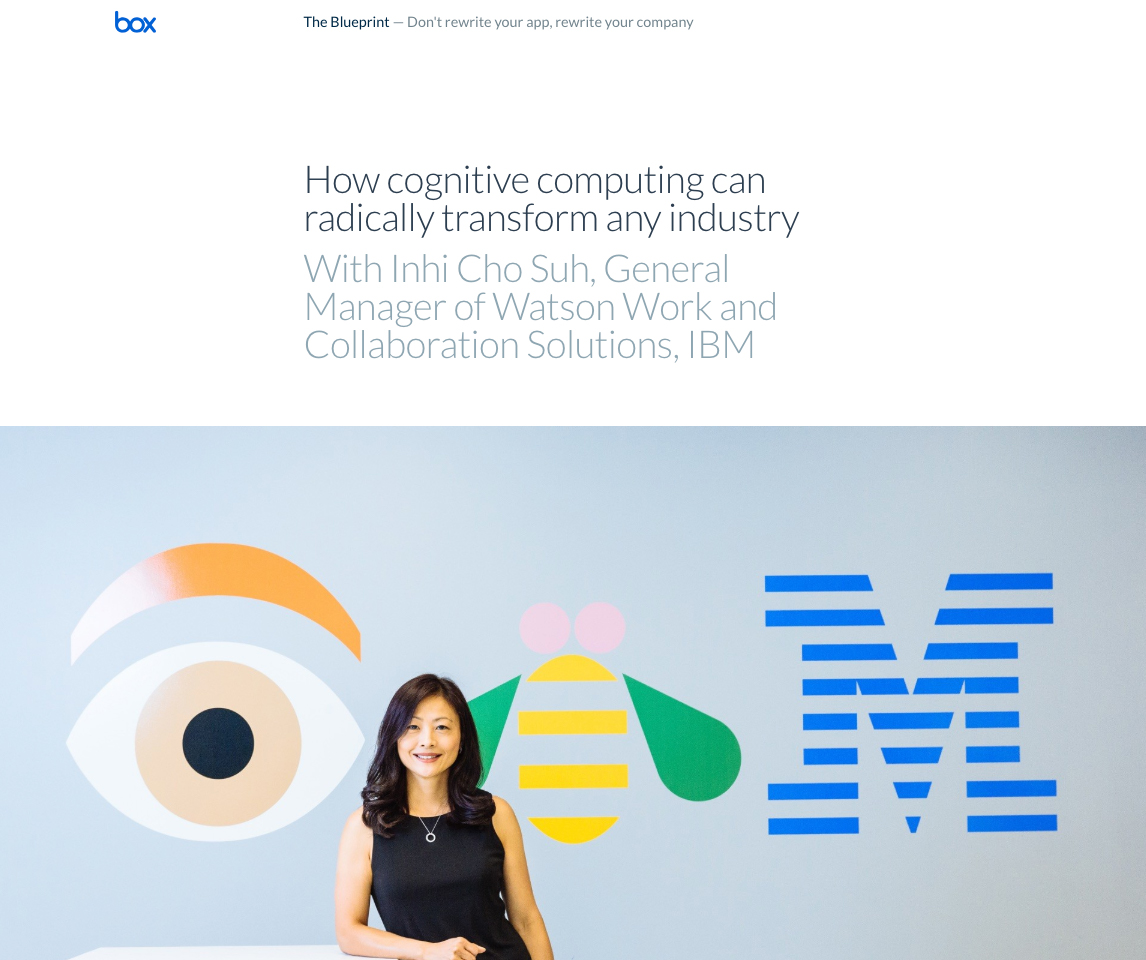
The Blueprint, a thought leadership engine for Cloud Content Management.
